Last Gen Versions of Next Gen Games
It is a staple as old as, well, the NES/SNES era: two games that are the same title released on both the aging generation and the current one. Usually, these are flat-out the same game while other times, the older last-generation version is clearly lacking features to discourage you from playing it. This, at the time of this writing, has been ongoing for 35 years. For me, my most memorable encounter with this was the PS3/360 end-of-life era transitioning into the PS4/X1 era. This was the first time I didn’t see identical versions or scaled-down ports to handhelds, but flat-out broken games.
You had to really feel for those unaware gamers, picking up games like Assassin’s Creed IV: Black Flag or Watch Dogs on PS3 and encountering what felt like dollar-store knockoffs of the real thing. This marked the first time developers—and it wasn’t just Ubisoft—passed off these generation-straddling games to other teams or studios en masse. Watch Dogs on the PS3 and 360, for instance, is a game that on paper is the same as its big brother, but in practice it’s a messy clone with icy driving physics, missing textures (to the point you could confuse it for a late PS1 title), and what I’d describe as hornet-level AI. When I played through the game on PS4 a few years later, I recognized the plot, but the rest of the experience felt completely different. The AI wasn’t targeting me like I’d just awakened Skynet. The graphics were actually pretty good for its launch year—not the promised E3 trailer visuals, but solid. The biggest difference for me was the driving: it was actually enjoyable and not “Cars on Ice: Live in Chicago.”
What made this worse was that it wasn’t just a launch window issue. The Xbox 360 and PlayStation 3 stuck around way too long—so long that a generation of gamers didn’t even understand the normal console cycle. This created a strange but common situation: people were genuinely offended that new games weren’t coming out for their old systems anymore. From my personal experience, this lasted until late 2018, before then it felt like madness that we just kept moving this ancient hardware. Remember the Xbox 360 launched in 2005 and the PS3 in 2007, the fact people were still buying these things instead of the next generation ten years later was a sight to behold.
The PS4/X1 generation started in fall 2013. By the time people stopped asking for PS3/360 games and systems, the next generation was already two years away. I won’t sidetrack into Nintendo too much, but I’ll note that the Wii didn’t help things, offering the Wii U—which, while next-gen in every way, confused the market so badly that many people still think Nintendo went straight from the Wii in 2005 to the Switch in 2017. A simple fix would have been to have just called it the “Wii 2.”
Because the previous generation dragged on, we kept getting these broken ports all the way until 2015, before developers finally called it quits. Two years might not sound bad, but the refusal to go cold turkey ended up creating worse problems. As the PS4 and X1 era was winding down and the PS5 and Series X loomed on the horizon—set to launch in fall 2020—a global health crisis hit. Quarantines, lockdowns, and an economic shift left no one sure if Sony or Microsoft would even launch on time. They did, but with so few units available, many gamers were in no position to upgrade. The shift to next-gen was more of a trickle. Add in scalpers, and it was even less. Props to Microsoft for cutting off Xbox One games right away once their new console dropped—Sony, however, kept things going.
Even after the PS5 became widely available, Sony continued to support the PS4—not just with cross-gen games, but by outright downgrading new titles to work on old hardware, all the way until the end of 2022. That may not sound like much, but when first-party studios keep making games for the previous system, it sends a message to third-party developers to keep supporting it too. Normally, after a system’s replacement launches, releases for the old one dwindle to a trickle. That didn’t happen until 2025—yes, this year. While only a handful of PS4 games have released in 2025, the PS4 saw a whopping 100 new titles in 2024.
As a trophy hunter, I realize I’m in the minority in 2025. Most people buy a game—physically or digitally—and are awarded both the PS4 and PS5 versions for their pirchase. Then they load up the PS5 edition and call it a day. For me, though, it’s about maximizing not only the trophies I can earn, but also the time I spend. I’m a slower gamer by nature, but I beat more games than most because I keep going and chip away constantly. Some PS4 games offer what’s called an auto-pop, where you can earn the full Platinum trophy (100% completion) and then load up the PS5 version and get a second one. That’s always cool to me, and usually worth playing the slightly inferior version—at least, that’s what I tell myself until I hit something like Far Cry 6.
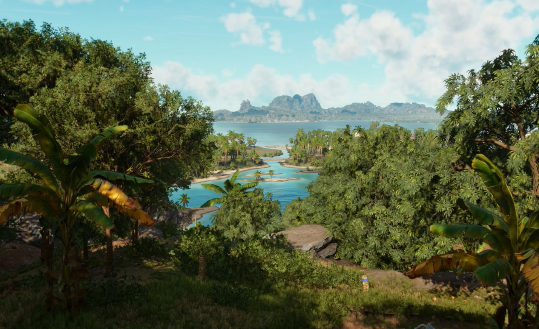
Somehow, it always comes back to Ubisoft. Far Cry 6, released in 2021, was the game that made me re-evaluate what the hell I was doing to myself. Normally, when I play an inferior version, it’s fine—not as pretty as PS5, but as someone who’s not big on eye candy, that doesn’t matter much. But Far Cry 6 felt like a punch in the head.
Instead of realistic dirt on NPCs’ faces, it was like a weird, thick texture awkwardly glued to their skin. The game was dark—not thematically, but visually—when I usually think of Far Cry as bright and beautiful, a stark contrast to its darker narratives. There was texture tearing too, with telephone poles looking sliced in half from a distance, but the worst offender was the frame rate. Locked at 30FPS, it created this bizarre uncanny valley effect, like the world and the character were moving at different speeds. I haven’t seen anything like that since Superman Returns on Xbox 360 back in 2006. “Far Cry 6 PS4: Motion Sickness Simulator” is certainly a take—and it scared me to learn that Ubisoft kept making PS4 versions for another two years.
So instead of torturing myself with that monstrosity, I installed the PS5 version. Instantly, the difference was night and day: smooth motion, bright colors, a night sky that wasn’t just black, and—most importantly—a playable game. As someone who still plays a lot of retro games across generations, it’s never as simple as “new is good, old is bad.” It’s about whether a downport is justified—whether it offers a comparable experience or not. Plenty of games have done this well by changing mechanics or presentation to suit older hardware, offering players something still worth playing.
Gamers shouldn’t have to lose faith in a franchise just because a developer made the wrong call. A great example of doing it right? Mortal Kombat X. When it became clear the game wouldn’t work on PS3/360, they canceled those versions. Sure, some fans were disappointed at the time, but when they finally got their hands on the game on PS4/X1, the experience wasn’t tainted by a subpar version.
No trophy or achievement is worth ruining an experience over—whether that’s playing a worse version out of FOMO on trophies or forcing yourself to replay Star Ocean 4 an ungodly number of times. Life’s short. If you like achievement hunting, then do what interests you. Perfection doesn’t matter, there will always be people that try to one up your accomplishments. The truth is clearly, these developers aren’t chasing perfection either—just a quick buck, even if it means shipping an unplayable mess.